2026 Update · A Complete Guide to Rhinoplasty Price in Korea
Full rhinoplasty in Korea commonly costs 4,000,000–5,500,000 KRW (about $2,667–$3,667). This guide explains prices by procedure and compares TOP CLASS Plastic Surgery’s limited 1,500,000 KRW (about $1,000) primary bridge-and-tip deal, so you can compare the typical range with a lower-priced current option.
Quick Answer
Based on the latest 2026 data, full rhinoplasty in Korea commonly costs ₩4.0–5.5M. Prices for tip, bridge, cartilage, and revision procedures range from ₩1.0–9.0M.
This guide also explains extra fees. A ₩1.0–2.0M quote usually means a limited tip, bridge, alar, or hump procedure, not a full bridge-and-tip rhinoplasty.
PRICE UPDATE · AUGUST 27, 2026
We added TOP CLASS Plastic Surgery’s limited 1.5M KRW primary bridge-and-tip rhinoplasty deal. The general 4.0M–5.5M KRW range remains unchanged, so you can compare the current deal with the typical Korean price in one place.
TOP CLASS Plastic Surgery currently offers primary bridge-and-tip rhinoplasty at 1,500,000 KRW (about $1,000) before VAT. The offer sits well below the 4.0M–5.5M KRW range commonly compared for full primary rhinoplasty in this guide, but surgery must be completed by September 12, 2026.

Why this deal is worth a closer look
It covers first-time bridge-and-tip rhinoplasty, with bulbous, short, or hump nose correction included when Dr. Yong-Hoon Jeon finds it clinically required during this first-phase offer. Surgery must be completed by September 12, 2026.
What the final payment can look like
The displayed 1.5M KRW price becomes 1.65M KRW after 10% VAT. Medicine is about 50K KRW. Donated-rib cartilage changes the plan to 3.0M KRW before VAT, and optional alar-base reduction is quoted separately.
This offer is included not only because it is lower-priced. The current promotion names Dr. Yong-Hoon Jeon, a board-certified plastic surgeon with 28 years of experience since 1998, and shows actual TOP CLASS clinic cases. A separate Doctor’s Note later in this guide explains TOP CLASS’s material-planning background; it is not a review of this current offer.
See the TOP CLASS materials note ↓
| What you are planning | 2026 Korea price | What the range means |
|---|---|---|
| TOP CLASS limited primary bridge + tip rhinoplasty | ₩1.5M ($1,000) | Before VAT; surgery by Sep 12; six photo reviews; refundable 300K deposit |
| Limited procedure | ₩1.0–2.0M | Tip, bridge, alar, or hump correction only |
| Full rhinoplasty | ₩4.0–5.5M | The most common full bridge-and-tip range in this dataset |
| Complex procedure | ₩5.0–9.0M | Revision, rib cartilage, osteotomy, implant-free, or structural rebuilding |
Tap a topic to jump
New · TOP CLASS limited 1.5M KRW deal
1. Rhinoplasty prices by procedure in Korea
2. How much does revision rhinoplasty cost in Korea?
3. How much does tip plasty alone cost?
4. How do materials, cartilage, and technique change the price?
5. What extra fees should your quote include?
6. Why should you not choose a clinic by price alone?
Most people searching for rhinoplasty price are referring to primary rhinoplasty — their first nose surgery.
But rhinoplasty is not one fixed procedure.
It can range from smaller corrections such as tip plasty, nose bridge augmentation, alar reduction, or hump reduction, to more structural cases using septal cartilage, ear cartilage, rib cartilage, osteotomy, tip extension, or revision rhinoplasty.
That is why rhinoplasty prices in Korea can vary depending on what part of the nose is treated, what materials are used, and how much structure needs to be built.
How rhinoplasty prices are structured in Korea
Simple procedures
Tip plasty, nose bridge augmentation, alar reduction, or hump reduction
1,000,000 – 2,000,000 KRW

Case from  SHINSANG Plastic Surgery · Tip surgery
This is a good example of how a smaller tip-focused procedure can still create a visible profile change, even when the front view stays relatively subtle.

Coralee said
“I am so happy with the nose line! From the front it look very similar, but the side profile it’s a lot higher.”
Procedure reviewed at SHINSANG Plastic Surgery
Primary rhinoplasty
Bridge and tip treated together using cartilage depending on structure
3,000,000 – 7,000,000 KRW

Case from  DM Plastic Surgery · Primary rhinoplasty
This shows how a natural-looking primary rhinoplasty can still include several structural elements at the same time.

Johanna said
“My procedure included alar reduction, rib cartilage for the nasal tip from a donor, and a thin silicone implant to slightly raise the bridge.”
Procedure reviewed at DM Plastic Surgery
Advanced structural cases
Osteotomy, tip extension rhinoplasty, or more complex structural correction
5,000,000 – 7,000,000 KRW
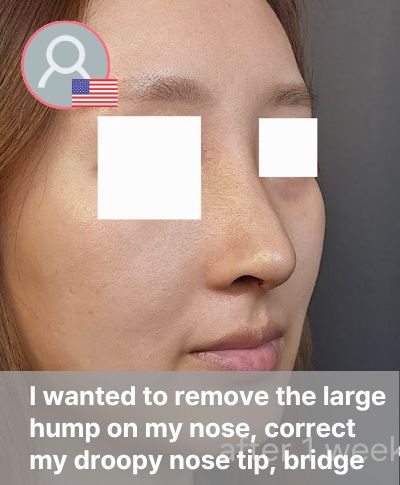
Case from  RUBY Plastic Surgery · Hump removal / bridge augmentation / tip correction
Some cases move beyond a single cosmetic concern and start involving multiple structural corrections, which is why the price range rises.

Amy said
“He suggested hump removal, bridge augmentation, drooping tip correction, subdermal graft, donor rib cartilage (if needed) and thread removal (if needed).”
Procedure reviewed at RUBY Plastic Surgery
No-implant rhinoplasty
Bridge and tip built using only autologous cartilage
7,000,000 – 9,000,000 KRW

Case from  LAST Plastic Surgery · No-implant rhinoplasty
This is a clear example of a patient who wanted a softer result without silicone, and whose surgical plan was built completely around her own cartilage.

Jangmi_ said
“I decided to go with no-implant and he recommended me using one side of ear cartilage together with nasal septum cartilage.”
Procedure reviewed at LAST Plastic Surgery
Revision rhinoplasty
Correcting or rebuilding a nose after previous surgery
5,000,000 – 8,000,000 KRW

Case from  VG Plastic Surgery · Revision rhinoplasty
Revision rhinoplasty is often harder because the surgeon is not starting from a clean structure. Previous implants, limited support, or difficult anatomy can all change the plan.

Lilith (Shin) said
“Rib cartilage will be used for my tip... my implants are already high... We’ll try to make them even higher, but no guarantees.”
Procedure reviewed at VG Plastic Surgery
The table below shows the rhinoplasty procedures people actually search for, with typical price ranges and what each option is usually best for.
| Procedure | Typical Price | Best for |
|---|---|---|
| Reviewer / Model rhinoplasty | 0 – 1,000,000 KRW | Special pricing for patients participating in review or model conditions |
| Tip plasty | 1,000,000 – 2,000,000 KRW | When you only want to refine the tip shape slightly |
| Nose bridge augmentation (Implant) | 1,000,000 – 2,000,000 KRW | When you want to raise the bridge of the nose |
| Alar reduction (Alarplasty) | 1,000,000 – 2,000,000 KRW | When the nostrils look wide or flared |
| Hump reduction | 1,000,000 – 2,000,000 KRW | When you want to remove a dorsal hump |
| Nose bridge (Implant) + Nose tip augmentation (Primary) | 3,000,000 – 4,000,000 KRW | When you want to improve both bridge and tip together |
| Rhinoplasty with septal cartilage | 3,500,000 – 4,500,000 KRW | When you need stronger and more stable tip support |
| Rhinoplasty with ear cartilage | 4,000,000 – 5,500,000 KRW | When you want a softer and more natural-looking tip |
| Rhinoplasty with rib cartilage | 4,500,000 – 7,000,000 KRW | When a stronger structure or bigger change is needed |
| Rhinoplasty with osteotomy | 5,000,000 – 6,000,000 KRW | When the nose is wide or needs bone reshaping |
| Tip extension rhinoplasty | 5,000,000 – 6,500,000 KRW | When the nose looks short or upturned |
| Deviated nose correction | 5,500,000 – 7,000,000 KRW | When the nose is crooked or asymmetrical |
| No implant rhinoplasty | 7,000,000 – 9,000,000 KRW | When you want a fully natural result without implants |
| Revision rhinoplasty | 5,000,000 – 8,000,000 KRW | When you want to correct a previous surgery |
Olivia’s note
Rhinoplasty prices are not fixed.
They change based on structure, materials, and how much needs to be rebuilt.
That’s why two people both saying “nose job” can still end up in completely different price ranges.
Revision rhinoplasty does not follow the same pricing logic as a first surgery.
Once a nose has already been operated on, the surgeon may be dealing with scar tissue, weakened support, less usable cartilage, implant issues, or asymmetry from previous work.
That is why revision rhinoplasty often overlaps with procedures such as rhinoplasty with rib cartilage, deviated nose correction, rhinoplasty with osteotomy, or implant removal and reconstruction. It is not simply “doing the same surgery again.”

primary vs revision comparison
Primary average
4,700,000 KRW
Revision average
6,200,000 KRW
The most common revision range usually sits around
5,000,000 – 8,000,000 KRW
and can move higher depending on how much needs to be rebuilt.
Olivia’s note
Revision rhinoplasty is where patients most often realize that the first surgery should never be chosen on price alone.
A cheaper first decision can later turn into a more expensive structural correction.
One of the most common questions in rhinoplasty consultations is:
“Can I just do tip plasty?”
The answer is: sometimes, yes — but much less often than people expect.
In many real cases, what looks like a “tip problem” is actually connected to the bridge height, projection balance, skin thickness, or overall facial harmony.
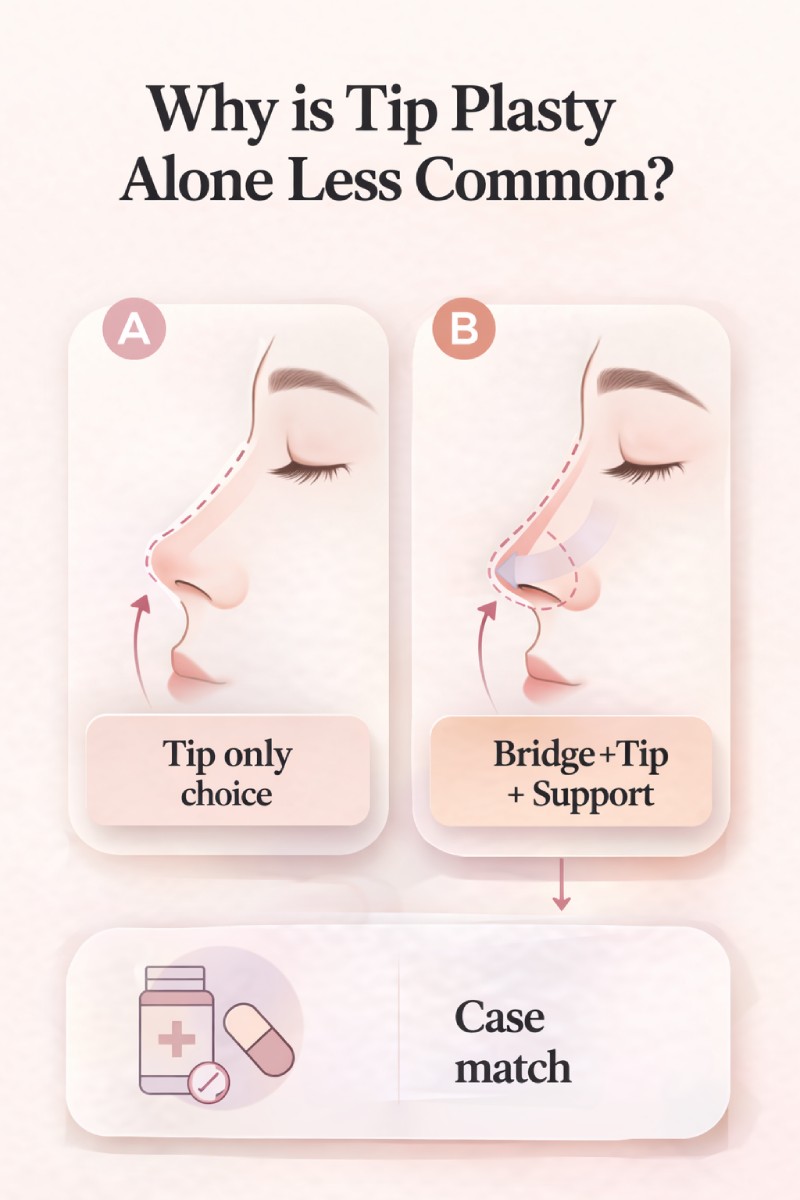
tip-only vs bridge+tip connection
Tip plasty alone
→ possible in small and limited cases
But more often
→ bridge + tip + support planning go together
Doctor’s Note
Dr. CHOI, JUNG-HYEOK
 APGUJEONG SEOUL Plastic Surgery
Why bridge + tip alone is often not enough
Based on guidance shared by Dr. CHOI, JUNG-HYEOK, rhinoplasty should not be understood as changing only the bridge and tip in isolation. He explains facial harmony from a broader structural point of view: the relationship between the forehead, eye area, nose, and chin affects whether a nose looks balanced, youthful, natural, or overly projected.
In other words, a nose that is simply made “higher” does not automatically look better. In flatter facial structures, the surgeon often has to think about overall projection, line flow, and how the bridge and tip connect with the rest of the face. That is one reason a simple bridge-only mindset can be too narrow, and one reason Nose bridge (Implant) + Nose tip augmentation, Rhinoplasty with septal cartilage, Rhinoplasty with ear cartilage, or Tip extension rhinoplasty may be chosen instead of a smaller one-part correction.
This also helps explain why tip plasty alone is less common than many patients imagine. The real question is often not just “Can I make the tip prettier?” but “How should the bridge, tip, projection, and facial balance work together?”
All about MEI has been working with APGUJEONG SEOUL Plastic Surgery since May 11, 2016. That long partnership gives us a wider view of how this clinic has consistently explained rhinoplasty structure and balance over time.
*This note is for general education and does not replace personal medical advice.

Olivia’s note
Many patients come in saying they only want a smaller or prettier tip.
But once the full profile is checked, the better question becomes: “Do the bridge and tip need to be planned together?”
One of the biggest reasons rhinoplasty price changes is not just the surgery name, but what material is used, which cartilage is selected, and how much structure needs to be created or supported.

cartilage and structural planning image
Septal cartilage
Located inside the nose, septal cartilage is commonly used for support and structure. It is often selected when the tip needs stronger projection or a more stable framework.
Ear cartilage
Ear cartilage is softer and naturally curved, which is why it is often used when patients want a softer and more natural-looking tip.
Rib cartilage
Rib cartilage is used when stronger structure is needed, especially in more difficult primary cases or revision rhinoplasty.
Additional soft tissues
Dermofat, fat, or fascia can also be used to soften the result, cover implants, or improve thin-skin and visible-implant concerns.
This is why the choice of cartilage is one of the biggest factors that determines both the final shape and the price of rhinoplasty.
Doctor’s Note
Dr. KIM, HYUNG-JOON
What different materials really change in rhinoplasty
Based on material explanations shared by Dr. KIM, HYUNG-JOON, one reason rhinoplasty prices vary so much is that “implant rhinoplasty” is not one uniform category. The bridge can be shaped with materials such as silicone, Gore-Tex, Silitex, or artificial dermis, and each material has a different balance of softness, stability, ease of shaping, and long-term behavior.
Silicone remains one of the most widely used bridge implants because it is relatively stable, familiar to many surgeons, and can be shaped to the desired bridge line. Gore-Tex is softer and integrates more with surrounding tissue, but can be harder to modify later. Silitex is positioned as a material that tries to combine some of the advantages of silicone and Gore-Tex. Artificial dermis may also be considered in certain situations where camouflage, softness, or surface improvement matters.
On the cartilage side, septal cartilage gives more internal support, ear cartilage helps create a softer and more natural-looking tip, and rib cartilage becomes important when stronger structure is needed. In thinner-skin or difficult cases, additional tissues such as dermofat or fascia may also be used to soften the result or improve visible implant concerns.
That is exactly why a row like Nose bridge augmentation (Implant) does not mean the same thing as Rhinoplasty with septal cartilage, Rhinoplasty with ear cartilage, Rhinoplasty with rib cartilage. The surgeon is not only choosing a shape — he is choosing the material logic behind the result.
All about MEI has been working with TOP CLASS Plastic Surgery since May 17, 2016. That long partnership matters because it means we have seen this clinic’s rhinoplasty positioning, consultation logic, and material explanations across many years.
*This note is for general education and does not replace personal medical advice.
Olivia’s note
This is the part many price-comparison pages skip.
A nose job is not just “higher bridge” or “smaller tip.”
Material choice, cartilage type, facial balance, and structural planning all affect both the shape and the quote.
When people compare rhinoplasty prices, they often look only at the procedure label or the advertised number.
But the final payment logic can still depend on what is included in the quote.

total cost breakdown
Surgery fee
The main quoted price for the procedure itself
Pre-op tests
Often included, but still worth confirming
Anesthesia
Can already be included in many quotes, but not always explained clearly
VAT
Usually important to confirm in the final total
Prescription medicine
Often billed separately after surgery
Plan changes
The quote can change if the surgical plan changes after in-person evaluation
A row like Rhinoplasty with septal cartilage or Rhinoplasty with rib cartilage already implies a different level of structure and planning than a simple bridge-only procedure.
That is why checking what is actually included still matters.
Price matters. Everyone checks price first.
That part is normal.
But one real consultation pattern appears again and again:

lower price first → dissatisfaction → revision concern
“To get the result you want, you may need more than a simple procedure.”
→ but the patient still chooses the lower option first
lower price first
→ not enough change
→ dissatisfaction
→ revision concern
This is especially common when patients try to force a full structural goal into a smaller procedure such as tip plasty only, bridge augmentation only, or a limited correction that does not truly match the case.
Your first choice matters a lot.
A lower price that does not match your real structural need can cost more later.
In Korea, rhinoplasty promotions are often not just simple discounts.
Many are tied to conditions such as review participation, timing, or case fit.

rhinoplasty promotion / deal types
Review-based deals
Lower cost in exchange for review participation or photo consent
Model conditions
Better pricing can be possible, but exposure requirements are usually broader
Seasonal promotions
Timing matters, but not every case fits every offer
Case matching
The right question is not only “Is it cheaper?” but “Does it fit my case?”
Olivia’s note
A good rhinoplasty deal can absolutely help.
But the better question is not only “Is this cheaper?”
It is “Does this fit the kind of bridge, tip, cartilage, and structural planning I actually need?”
Based on quoted prices after consultation and surgical planning, the most common range for full primary rhinoplasty is 4,000,000 – 5,500,000 KRW
Sometimes, yes. But this usually applies only to limited procedures such as tip plasty, nose bridge augmentation only, alar reduction, or hump reduction. It is not the standard price for a full bridge-and-tip rhinoplasty.
Revision rhinoplasty often involves scar tissue, structural changes from previous surgery, less usable cartilage, asymmetry correction, implant-related issues, and more difficult rebuilding.
Because each cartilage type plays a different role in support, softness, projection, and structural rebuilding. Stronger or more complex support usually means more advanced planning and a higher quote.
Yes. A current example is TOP CLASS Plastic Surgery’s 1.5M KRW primary bridge-and-tip promotion before VAT. It can be useful when the case, September 12 surgery deadline, and six-photo-review condition fit, but cartilage choice, optional alar-base reduction, and the final consultation may change the total cost.
Final thought
Korean rhinoplasty prices are not one fixed number.
Different procedures, materials, and cartilage choices follow different logic.
This guide is not meant to sell one number.
It is meant to help you understand what each procedure means, why the price changes, and what kind of rhinoplasty may actually fit your case.
Written by Olivia Bennett, Medical Coordinator on All about MEI
STAY ALERTED
Follow rhinoplasty clinics and procedures in the All about MEI app to compare current deals, surgical scope and real patient TALKS before booking.
Bridge work, tip surgery, septal work and revision complexity should not be priced as the same operation.
Not ready to consult today? Keep your interest with All about MEI.












 TOP CLASS Plastic Surgery