Korea double eyelid decision guide · method · cost · recovery · ptosis
Choose non-incisional surgery when thin eyelids hold a crease. Choose incisional surgery when the eyelids are thick, puffy, loose, or a previous buried-suture crease has disappeared.
Quick Answer
Thin eyelids that hold a crease fit non-incisional surgery. Thick, puffy, loose, or previously failed eyelids fit incisional surgery.
Choose non-incisional when there is little fat or loose skin and a crease forms easily. Choose incisional when tissue weight hides the crease or a previous non-incisional crease disappeared. Check ptosis separately when weak eyelid-opening power causes sleepy-looking eyes. In Korea, common price ranges are 1M–1.5M KRW for non-incisional and 1.5M–2.5M KRW for incisional surgery.
👇 Tap to jump 👇
1. Which double eyelid surgery should I choose in Korea?
2. Choose non-incisional double eyelid surgery if your eyelids are thin
3. Choose incisional double eyelid surgery if your eyelids are thick, puffy, or loose
4. Cost and recovery comparison in Korea
5. Pinch test and ptosis correction before surgery in Korea
Thin eyelids should choose non-incisional double eyelid surgery in Korea. Thick, puffy, loose, or heavy eyelids should choose incisional double eyelid surgery in Korea.
In Korea, non-incisional vs incisional double eyelid surgery is decided by eyelid thickness, upper-eyelid fat, loose skin, crease stability, and eyelid opening power.
Non-incisional double eyelid surgery is the better first option when the eyelid is thin, the upper eyelid has little fat, and the fold appears easily with eyelid tape or a pinch test.
Incisional double eyelid surgery is the better first option when the eyelid is thick, puffy, loose, heavy, or when a previous non-incisional crease disappeared.
| Your eyelid condition | Choose this | Korea cost | Early recovery |
|---|---|---|---|
| Thin eyelids, little fat, easy crease | Non-incisional | 1M–1.5M KRW | About 1 week |
| Thick, puffy, loose, or heavy eyelids | Incisional | 1.5M–2.5M KRW | About 2 weeks |
| Sleepy-looking eyes or weak opening power | Ptosis correction check | Clinic quote | Varies |
| Previous crease disappeared | Incisional or revision plan | Clinic quote | Varies |

Non-incisional double eyelid surgery uses suture fixation. Incisional double eyelid surgery uses an incision to adjust eyelid tissue and create stronger fixation.
Choose non-incisional double eyelid surgery in Korea if your eyelids are thin, have little fat, have little loose skin, and form a crease easily.
Non-incisional double eyelid surgery is also called buried suture, natural adhesion, or non-cutting double eyelid surgery depending on the Korean clinic. The core method is suture-based crease fixation without a full eyelid skin incision.
Choose non-incisional double eyelid surgery when you want a lighter early recovery and your eyelid tissue is already suitable for a suture-based crease.
Do not force non-incisional double eyelid surgery when your eyelids are thick, puffy, loose, heavy, or when the fold disappears quickly during a pinch test. In that case, a lighter method can become the wrong method.
A buried-suture crease is more likely to loosen when thick tissue repeatedly presses over the fold, loose skin covers the fixation, the planned line is too high, or a previous non-incisional crease has already failed. If two or more of these conditions apply, compare an incisional plan first instead of repeating the same weak fixation.

Non-incisional double eyelid surgery creates crease fixation with suture points instead of a full skin incision.
Choose non-incisional when
Thin eyelids · little fat · little loose skin · easy crease formation · faster early recovery goal
Do not force non-incisional when
Thick eyelids · puffy eyelids · loose skin · heavy eyelid tissue · fold disappears quickly
Natural-looking recovery is easier to judge when swelling, crease height, and eyelid thickness are seen together. This review shows why many thin-eyelid patients compare non-incisional double eyelid surgery first.

Coralee St-Laurent said
“The swelling went down faster than I expected, and it looked more natural than I thought.”
Choose incisional double eyelid surgery in Korea if your eyelids are thick, puffy, loose, heavy, or your previous crease disappeared.
Incisional double eyelid surgery allows the surgeon to adjust eyelid skin, fat, muscle, and fixation points directly. This makes incisional double eyelid surgery the stronger method when the crease needs structural support.
Choose incisional double eyelid surgery when thick eyelid tissue, puffiness, loose skin, or weak crease fixation makes a non-incisional crease unstable.
Do not avoid incisional double eyelid surgery only because you want a natural result. Incisional surgery looks obvious when the crease is too high, too deep, or too strong for the eyelid tissue. For thick or loose eyelids, a stable lower crease can look more natural than forcing a weak non-incisional crease.
The incision line is usually pink or firm early, then softens as swelling settles. Judge the final line after the tissues have relaxed, not during the first swollen weeks. A conservative crease height, balanced tissue removal, and fixation matched to eyelid thickness matter more for naturalness than the word “incisional.”

Incisional double eyelid surgery uses an eyelid incision to adjust skin, fat, muscle, and crease fixation.
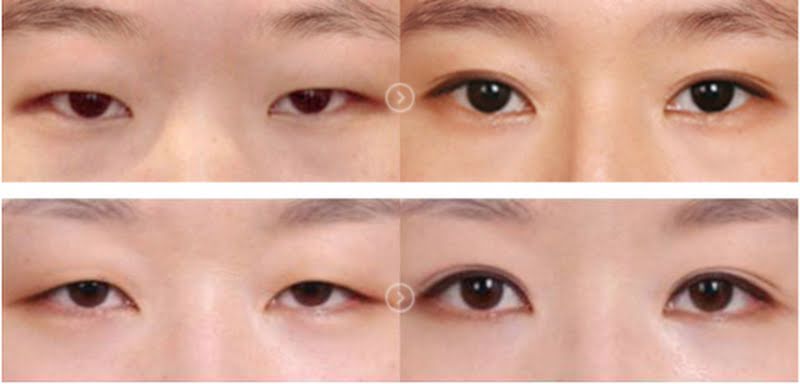
Thick eyelids need stronger crease fixation, and incisional double eyelid surgery is the better method when thick eyelid tissue buries a weak crease.
Choose incisional when
Thick eyelids · puffy eyelids · loose skin · weak crease fixation · previous crease disappeared
Natural result rule
A natural result depends on crease height, eyelid tissue correction, fixation strength, and swelling control.
Choosing incisional double eyelid surgery is often the right decision when eyelid thickness or crease stability matters more than short downtime.

Shannon Ong said
“I first thought about non-incisional, but after checking my eyelids properly, incisional made more sense.”
Non-incisional double eyelid surgery in Korea costs 1M–1.5M KRW with about 1 week of early recovery. Incisional double eyelid surgery in Korea costs 1.5M–2.5M KRW with about 2 weeks of early recovery.
| Method | Korea cost | Early recovery | Best for |
|---|---|---|---|
| Non-incisional | 1M–1.5M KRW | About 1 week | Thin eyelids |
| Incisional | 1.5M–2.5M KRW | About 2 weeks | Thick, puffy, or loose eyelids |
| Ptosis correction | Clinic quote | Varies | Sleepy-looking eyes |
In Korea, the final double eyelid surgery quote can change with ptosis correction, revision surgery, anesthesia, VAT, medication, stitch removal, review-model conditions, and combined procedures.
For international patients, price should be checked with the Korea travel schedule. A 1-week stay can work for many non-incisional cases, while incisional surgery or ptosis correction often needs a safer plan for swelling checks and stitch removal.
Swelling is most visible
Cold care, head elevation, medication, and a quiet schedule matter most. Incisional swelling is usually heavier.
Non-incisional is easier to show in public; incisional may need stitch removal
Bruising and asymmetry can still be visible. Do not judge crease height yet.
Early incisional recovery becomes easier to manage
Most daily activities are easier, but the line can still look high or firm in photos.
The crease and incision continue to settle
Residual swelling falls and scar firmness softens, although final healing can take longer. Revision decisions should not be rushed.
One-week recovery matters for overseas patients because consultation, surgery, stitch removal, swelling checks, and return travel often happen within one Korea trip.
Julie said
“After one week, most of the swelling had already gone down.”

Once you know which method you are comparing, check a real offer where the non-incisional and incisional prices are listed separately.

A crease that forms easily points toward non-incisional surgery. A crease that disappears quickly, heavy eyelids, or sleepy-looking eyes point toward incisional surgery or ptosis correction.
Use your fingers or tweezers to gently make a double eyelid fold. If the fold appears clearly and stays for a short moment, non-incisional double eyelid surgery is the first method to compare.
If the fold disappears quickly, gets buried under eyelid tissue, or does not form clearly, incisional double eyelid surgery is the first method to compare.
Ptosis correction should be discussed when the eyes look sleepy, the upper eyelid covers too much of the pupil, or the person uses forehead muscles to open the eyes. Double eyelid surgery creates a crease; ptosis correction improves eyelid opening power.
The pinch test is not a diagnosis, but it is a useful first check before comparing double eyelid surgery methods in Korea.
Doctor’s Note
Dr. Jeon, Yong-Hoon
Do I need ptosis correction or only double eyelid surgery?
Double eyelid surgery and ptosis correction solve different problems. Double eyelid surgery creates or fixes the eyelid crease. Ptosis correction improves eyelid opening power when the upper eyelid lifting muscle is weak.
Non-incisional double eyelid surgery is enough when the eyelid skin is thin, the fold forms easily, and the eye-opening power is normal. Incisional double eyelid surgery is better when the eyelid is thick, puffy, loose, or needs stronger crease fixation.
Ptosis correction should be discussed when the eyes look sleepy, the upper eyelid covers too much of the pupil, or the patient uses the forehead to open the eyes. In this case, making only a double eyelid crease may not fully improve the tired-looking eye shape.
The final plan should separate three decisions: crease method, crease height, and eyelid opening power. A natural result comes from matching all three, not from choosing non-incisional or incisional surgery by name only.
*This note is for general education and does not replace personal medical advice. Final treatment decisions require in-person medical consultation.
First choose the method that fits your eyelid. Then compare the exact price, inclusions, surgeon, recovery support, and booking conditions.
Check whether the quote is for non-incisional, incisional, or revision surgery and whether ptosis correction is included. Confirm VAT, anesthesia, medication, stitch removal, aftercare, review-model requirements, and language support before booking.
If a previous buried-suture crease disappeared, disclose the date, method, and number of prior procedures. Revision tissue can change fixation and price, so a first-time package may not match the actual plan.

Yes. Loosening is more likely when the eyelid is thick or puffy, loose skin covers the fold, the crease is designed too high, or a previous buried-suture crease has already failed.
No. A conservative crease height and fixation matched to the eyelid can look more natural on thick or loose eyelids than an unstable non-incisional crease.
The line is commonly pink or firm early and softens over the following months. Judge the settling trend during months 1–3, not during the first swollen weeks; final healing can take longer.
Compare an incisional or revision plan first. Repeating buried sutures can work only when the eyelid remains thin and the cause of loosening can be corrected.
Plan about 7–10 days when stitch removal or a swelling check is needed. Non-incisional cases can be shorter, while incisional, ptosis, or revision plans need more schedule room.
Final decision
Thin eyelids that hold a crease: choose non-incisional.
Thick, puffy, loose, or previously failed eyelids: choose incisional.
Weak eyelid-opening power: check ptosis separately.
Choose the method your eyelid tissue can hold, then compare recovery and current deals.
Written by Olivia Bennett, Medical Coordinator on All about MEI
Medically reviewed by Dr. Jeon, Yong-Hoon, TOP CLASS Plastic Surgery
This guide is for general education and does not replace personal medical advice. Final treatment decisions should be made after consultation with a qualified medical provider.











 TOP CLASS Plastic Surgery